
The Smell of a Place

Every time I’ve walked in or out of the front gate of our rental in Oxfordshire recently I have, literally, stopped to smell the… OK not the roses, but the pretty white plant that grows right there and smells absolutely heavenly. Not being very green-fingered and knowing that honeysuckle smells pretty good, I’ve been telling everyone to sniff the honeysuckle for about a week. Today, with the renewed energy a Monday morning can sometimes inspire, I Googled it.
It’s not honeysuckle (which I suppose I’m now going to have to admit to my family), it’s Koreanspice Viburnum. From now on, I have decided, I have to have that plant in my life. The truth is you can’t just smell it close-up, you can smell its glorious, heady scent as soon as you open the door or when you’re walking up the drive at dusk. I know, in a way you don’t always know when you’re creating a memory, that that scent will forever transport me back to this period of my life, in this house, opening the gate and walking towards the little stone porch, with the dogs scratching the paint off the door on the other side in their urgency to greet us.
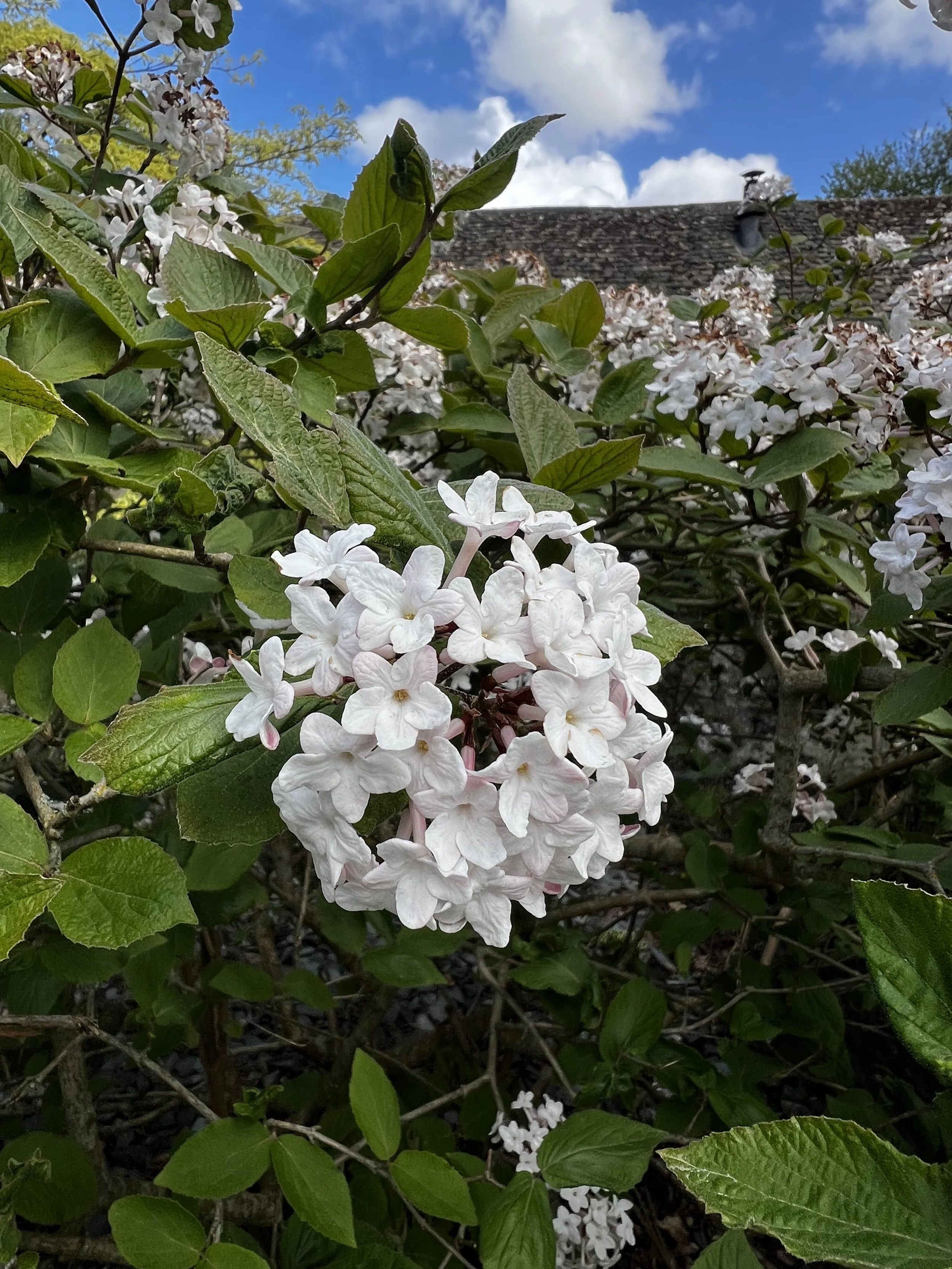
Not honeysuckle
Full disclosure, I don’t have the best “nose”. My youngest can confidently step outside and declare “it smells like spring today!” when there’s still snow on the ground but somehow something subtle in the air has shifted, whilst I struggle to tell the difference between the smell of burnt toast and coffee (I know, it’s awful, I’m ashamed).
For me, it’s music. Music, even just a hint of a beat or two familiar notes played in succession wakes my brain up and has all my synapses firing. I find patterns that may or may not be there, and am instantly transported back to a time or place where that piece of music, or something similar, played - accompanied by all the emotions and senses of the day. Let’s just say I’m the person you want in your quiz team for the music round.
But what I discovered today is that far more people are transported by scent than by music. In fact, scents follow a direct, hardwired path to the brain. When you hear a piece of music or you see or feel something, the sensory input passes through the thalamus - the brain’s relay station - before being processed. But scent bypasses the thalamus, instead going directly to the limbic system. Because it skips the rational, analytical part of the brain it can trigger a memory before you even recognize the smell (Doesn’t science just rock by the way?).
This may have been news to me this morning, but a little delving reveals I am about 120 years behind the curve. It seems that even as far back as the 1910s cinemas would spray perfumes through ventilation systems during scenes. This rather crude attempt wasn’t very successful because the smells would linger way beyond the pretty floral scene into the murder scene (for example) and therefore proved… somewhat distracting.
Smell-O-Vision in the ‘50s and 60s piped scents in sync with scenes directly to cinema seats. By the top end of the last century we had scratch and sniff (and those awful scented markers that smelled absolutely nothing like the things they were supposed to smell like - chemical raspberry anyone?).
Today people are still working on getting scent into VR and immersive gaming environments. But the bottom line is that (so far) none of these smelly-ventions have really taken off. Smell is powerful, but it’s so much harder to control than sight or sound. Smells can’t be “cut” at the end of a scene and they linger and blend in unpredictable ways.
So, as a designer and a marketer, my best bet until the tech catches up is not to make you smell something, but to evoke a smell. To show you an image or a moment - a steaming cup of coffee being stirred in a quiet kitchen, late afternoon light catching the edge of a table - that makes you remember a scent without ever quite naming it.
Because when that happens, something deeper is triggered. Not just recognition, but feeling. Memory. A sense of place.
And that’s really what we’re trying to do.
When I talk to clients about branding they often assume we’re going to be focusing on typography, colours and a logo. And of course, we do. But those are just the visible parts. The more interesting piece to explore is - how do you want someone to feel when they encounter your brand?
Because whether through imagery, sound, narrative - or merely the suggestion of something familiar and sensory - we’re trying to place someone somewhere. To create a moment they recognise, even if they’ve never experienced it exactly like that before.
Something that lingers, just slightly.
A bit like that scent at the gate. There before you even realise you’ve noticed it.
Thought for the day:
If your imagery doesn't evoke a feeling, it’s decoration. If it does, it becomes a memory.